Windows
 macOS
macOS Linux
Linux Android
 iOS
iOSTraverse VPN vs NordVPN: A Feature-by-Feature Comparison (2026)

Written by
Shubham Sharma
Shubham Sharma
VPN Researcher & Technology Writer
Shubham Sharma specializes in VPNs, online privacy, and cybersecurity content. He researches and tests VPN services, evaluates privacy policies, compares security features, and analyzes real-world performance to help readers make informed decisions. His goal is to provide clear, accurate, and unbiased information about online security tools.

Reviewed by
Jake Walker
Jake Walker
Founder & CEO, Traverse VPN
Jake Walker is the Founder and CEO of Traverse VPN, with a strong focus on digital privacy, internet security, and online freedom. He reviews VPN-related content to ensure technical accuracy, transparency, and alignment with industry best practices. His expertise includes VPN technology, encryption standards, and privacy-focused solutions.
Last updated:
Expert Verified✓
.jpeg)
Choosing the right VPN in 2026 is not just about picking the biggest name on the market. It is about finding a product that fits how you actually browse, work, and protect yourself online every day — without overpaying for features locked behind expensive upgrade tiers.
When users search for Traverse VPN vs NordVPN, most comparison pages lead with legacy metrics like server count, audit history, and brand age. Those factors are worth reviewing. But they do not tell you which VPN includes ad blocking on your base plan, which one protects against IPv6 leaks, or which one you can actually afford to keep running month after month.
Traverse VPN offers AES-256-GCM encryption, WireGuard/OpenVPN/IKEv2 support, DNS/WebRTC/IPv6 leak protection, kill switch, split tunneling, Clean Web ad blocking, anti-malware, unlimited bandwidth, and up to 10 devices on Windows, macOS, Android, iOS, and Linux. All features are included in the entry plan with no upgrades needed.
NordVPN is a trusted VPN with 9,000+ servers, six no-logs audits, and strong public benchmarks. It is a great choice for users who want verified auditing and a massive server network. However, for most everyday users looking for full privacy at a better price, Traverse VPN is often the smarter option.
Read more: Traverse VPN features · Traverse VPN for Windows · Traverse VPN plans
TL;DR — Quick Summary
- Traverse VPN supports WireGuard, OpenVPN (UDP/TCP), and IKEv2 with AES-256-GCM encryption — all three protocols confirmed on every plan, no tier gating.
- Built-in DNS, WebRTC, and IPv6 leak protection on all plans. Kill switch, split tunneling, Clean Web ad blocker, and anti-malware included by default — not as add-ons.
- Works on Windows 10 and 11 (x64, x86, ARM64), macOS, Android, iOS, and Linux with up to 10 simultaneous device connections per account.
- NordVPN has six independent no-logs audits, 9,000+ servers in 130 countries, and third-party speed benchmarks — but its ad blocker and anti-malware are restricted to higher-priced tiers, and its monthly rate is $12.99 with documented renewal price risk on long-term plans.
- Traverse VPN starts at $1.50/month and $9.59/year — enterprise-level security at the most accessible price in its class, with a 30-day money-back guarantee.
Bottom line: If you want complete privacy protection with no feature surprises at the best price available, Traverse VPN wins this comparison for everyday users.
How We Evaluated These VPNs
 How We Evaluated These VPNs
Most VPN comparisons focus on server counts, audits, and benchmark data, which favors older brands. But what matters more is which features you actually get for the price, how well your IP is protected, and whether the cost is worth it over 12 months.
This comparison evaluates both VPNs across six dimensions that affect daily privacy:
Protocol availability at base plan level — which protocols are actually usable without upgrading.
Encryption standard and cipher suite — not just whether AES-256 is used, but which mode, and what that means in practice.
Leak protection coverage — DNS, WebRTC, and IPv6 all three, because missing even one can expose your real IP address on modern networks.
Feature-tier mapping — which features are included at entry level versus locked behind higher tiers. This is where many VPN comparisons mislead buyers.
Real pricing over 12 months — introductory rates versus renewal rates, because the promotional price is rarely what you pay after year one.
Platform and architecture coverage — especially Windows ARM64, which many VPN clients still do not support natively in 2026.
Traverse VPN vs NordVPN: Head-to-Head Feature Comparison
The real difference between these two VPNs is not which one has more servers on a spec sheet. It is which one delivers a more complete everyday privacy experience at a price that works for real users.
| Feature | Traverse VPN | NordVPN |
|---|---|---|
| Supported protocols | WireGuard, OpenVPN (UDP/TCP), IKEv2 | NordLynx (WireGuard-based), OpenVPN, NordWhisper |
| Encryption | AES-256-GCM | AES-256 (OpenVPN), ChaCha20 (NordLynx) |
| DNS leak protection | ✓ All plans | ✓ Confirmed |
| WebRTC leak protection | ✓ All plans | ✓ Confirmed |
| IPv6 leak protection | ✓ All plans — confirmed | Partially confirmed |
| Kill switch | ✓ All plans | ✓ Two modes |
| Split tunneling | ✓ All plans | ✓ Available |
| Ad and tracker blocker | ✓ Clean Web — all plans | Higher tiers only |
| Anti-malware protection | ✓ All plans | Higher tiers only |
| Unlimited bandwidth | ✓ No caps or restrictions | ✓ |
| Simultaneous devices | Up to 10 — all plans | 10 |
| Windows architecture | x64, x86, ARM64 | x64, ARM |
| Platform coverage | Windows, macOS, Android, iOS, Linux | Windows, macOS, Linux, Android, iOS, Smart TVs, Browser extensions |
| No-logs policy | Strict — all plans | Audited 6 times, most recently Deloitte Nov–Dec 2025 |
| Independent audit | Not yet published (May 2026) | Six audits |
| Server count | 10 global high-speed locations | 9,000+ servers in 130 countries |
| Monthly price | $1.50/month | $12.99/month |
| Annual price | $9.59/year | ~$60/year (1-yr) or $3.39/mo on 2-yr plan with renewal risk |
NordVPN leads on server count, published audits, and platform breadth. Those are real advantages for a specific type of user. But for most everyday buyers, the more important story is this: Traverse VPN includes ad blocking, anti-malware, full leak protection across all three vectors, and three modern VPN protocols — all on the entry plan — at a price that is nearly nine times lower per month. That gap matters.
Transparency note: Traverse VPN has not published an independent no-logs audit as of May 2026. Users who require documented third-party verification before subscribing should review the privacy policy at traversevpn.com/privacy-policy. NordVPN's Deloitte audit remains the stronger documented record on this specific point.
Privacy and Security: What Each VPN Actually Delivers
Privacy is the most important factor in any VPN. The real difference between Traverse VPN and NordVPN is not just encryption, but which protections you actually get on the plan you pay for.
Traverse VPN: Security Built Into Every Plan
Traverse VPN uses AES-256-GCM encryption, which is stronger than older AES-CBC because it provides encryption and integrity protection at the same time. It supports
WireGuard, OpenVPN (UDP/TCP), and IKEv2, giving users flexibility for speed, stability, and mobile performance.
Traverse VPN also includes DNS, WebRTC, and IPv6 leak protection on every plan, helping prevent real IP exposure on modern networks. You also get a kill switch, split tunneling, and Clean Web ad blocking with anti-malware protection.
Most importantly, every security feature is included in the entry plan, with no upgrades required.
NordVPN: Strong Technology, But Many Features Cost Extra
NordVPN is well-known and uses strong encryption, RAM-only servers, and has multiple no-logs audits. It also offers advanced tools like Double VPN, Onion over VPN, and obfuscated servers.
However, many everyday protection features like ad blocking and anti-malware are locked behind higher-tier plans, making it more expensive for users who want full protection.
Bottom Line
NordVPN is a solid option for advanced users, but Traverse VPN delivers complete privacy protection upfront, making it the smarter and more practical choice for most users in 2026.
Protocol Deep Dive: WireGuard vs OpenVPN vs IKEv2
Understanding which protocol to use and when is one of the most practical things a VPN user can learn. Traverse VPN gives you all three options. Here is when each one gives you the best result.
Use WireGuard when: You want the fastest possible connection for everyday browsing, streaming, or gaming. WireGuard's lean codebase means lower latency and higher throughput compared to OpenVPN. It is the right default for most situations.
Use OpenVPN UDP when: You need a well-tested, widely compatible protocol on a standard open network. UDP mode is faster than TCP and works well on home networks and most mobile connections.
Use OpenVPN TCP when: You are on a restrictive network — a hotel, office, school, or airport — that blocks or throttles VPN traffic. TCP mode is slower but much harder to detect and block.
Use IKEv2 when: You are on a mobile device that regularly switches between Wi-Fi and cellular data. IKEv2 handles network transitions almost invisibly, maintaining your VPN connection without requiring you to reconnect manually.
This level of protocol flexibility is not standard across the VPN market. Many providers offer only one or two protocols, forcing users onto a single option regardless of their situation.
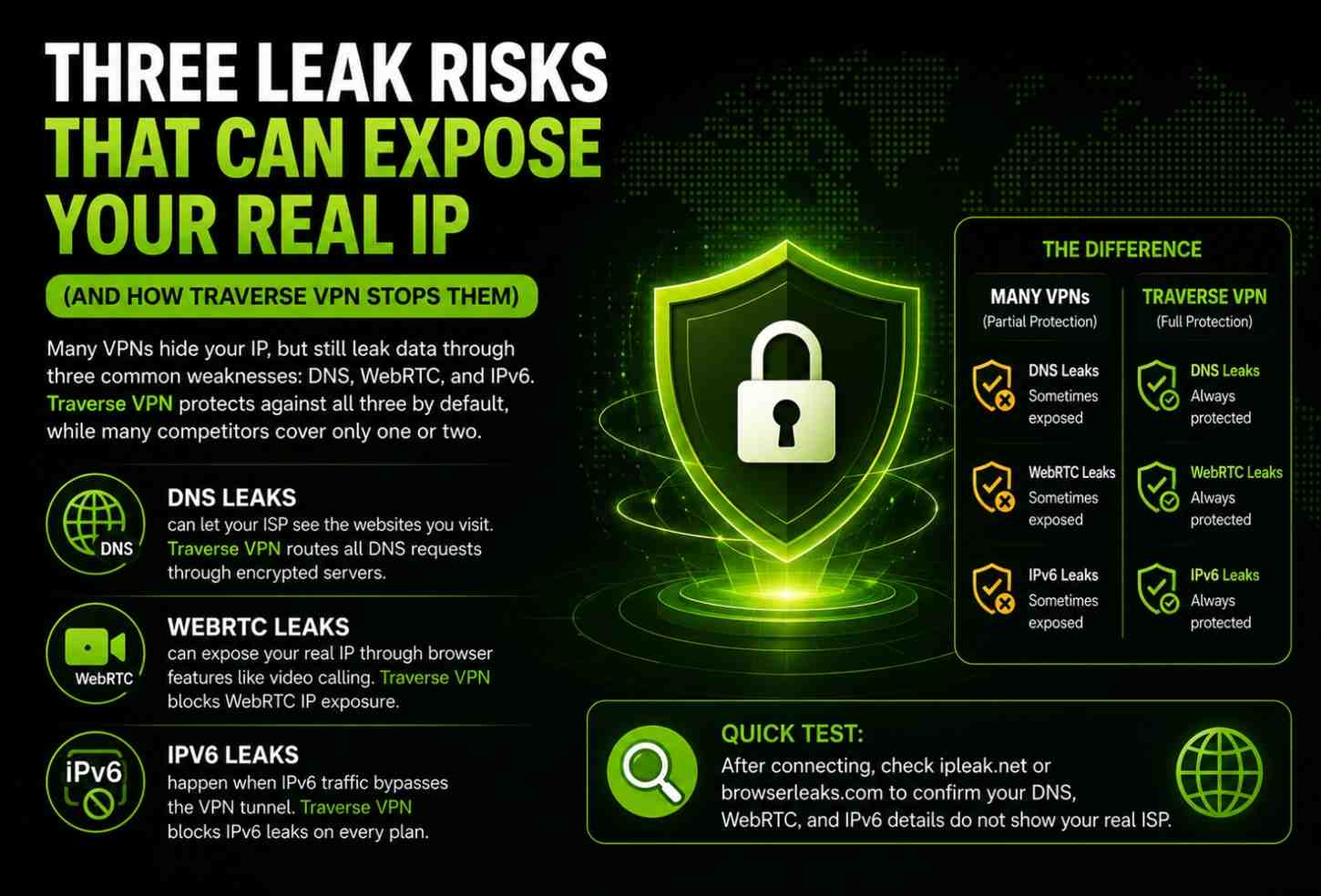
Three Leak Risks That Can Expose Your Real IP (And How Traverse VPN Stops Them)
Many VPNs hide your IP, but still leak data through three common weaknesses: DNS, WebRTC, and IPv6. Traverse VPN protects against all three by default, while many competitors cover only one or two.
- DNS leaks can let your ISP see the websites you visit. Traverse VPN routes all DNS requests through encrypted servers.
- WebRTC leaks can expose your real IP through browser features like video calling. Traverse VPN blocks WebRTC IP exposure.
- IPv6 leaks happen when IPv6 traffic bypasses the VPN tunnel. Traverse VPN blocks IPv6 leaks on every plan.
Quick test: After connecting, check ipleak.net or browserleaks.com to confirm your DNS, WebRTC, and IPv6 details do not show your real ISP.
Speed: What the Data Actually Shows
VPN speed comparisons are often misleading because results depend heavily on the protocol being tested.
NordVPN’s NordLynx delivers around 5–7% speed loss in third-party tests, mainly because it is built on WireGuard, which is faster than older protocols.
Traverse VPN also supports WireGuard natively on all plans, putting it in the same performance category. While Traverse VPN does not yet have widely published independent speed benchmarks (as of May 2026), WireGuard-based VPNs consistently outperform OpenVPN in real-world testing.
Both VPNs offer unlimited bandwidth and do not throttle speeds. For most users, speed differences on WireGuard are small and usually unnoticeable during streaming, browsing, or video calls.
Pricing: The Real 12-Month Cost of Each VPN
Introductory pricing and long-term pricing are often very different numbers. This section lays out what each VPN actually costs over time.
Traverse VPN charges $1.50 per month on the monthly plan, or $9.59 for a full year — an 18 percent saving. The price you see is the price you pay. All features are included at this rate with no tier structure.
NordVPN charges $12.99 per month on the monthly plan. Its lowest advertised rate of $3.39 per month requires a two-year upfront commitment, and that rate applies only to the first billing cycle. Renewal rates on NordVPN's long-term plans rise significantly after the introductory period — a factor that many comparison articles do not mention but that affects the real total cost of ownership.
At $9.59 per year, Traverse VPN costs less than NordVPN charges for a single month. That price includes WireGuard, OpenVPN, and IKEv2, AES-256-GCM encryption, all three leak protection systems, a kill switch, split tunneling, a Clean Web ad blocker, anti-malware protection, unlimited bandwidth, and 10 simultaneous device connections.
Five-VPN Market Comparison
| VPN | Protocols | Ad Blocker at Base | IPv6 Protection | Devices | Annual Price |
|---|---|---|---|---|---|
| Traverse VPN | WireGuard, OpenVPN, IKEv2 | ✓ All plans | ✓ Confirmed | 10 | $9.59/yr |
| NordVPN | NordLynx, OpenVPN, NordWhisper | Higher tier only | Partial | 10 | ~$60/yr |
| Surfshark | WireGuard, OpenVPN | ✓ Included | Not detailed | Unlimited | ~$38/yr |
| Proton VPN | WireGuard, OpenVPN, Stealth | Higher tier only | Not detailed | 10 | ~$48/yr |
| Mullvad | WireGuard, OpenVPN | Limited | ✓ Confirmed | 5 | ~$70/yr |
Traverse VPN is the only VPN in this table that includes ad blocking, anti-malware, and confirmed IPv6 leak protection all at once — at the lowest annual price in the comparison.
Which VPN Is Better in 2026? A Decision Guide by User Type
The honest answer is that the right VPN depends on what you specifically need. Here is a direct breakdown.
Choose Traverse VPN if:
You want every important privacy feature included on the base plan without paying for an upgrade. You use Windows on any architecture including ARM64. You need IKEv2 for mobile network switching. You want all three leak protection types confirmed. You want to cover multiple devices on a single account. You want the most accessible annual price in the market. You use Linux and want it treated as a fully supported platform.
Choose NordVPN if:
You require a documented independent no-logs audit before subscribing. You need access to specialty server types like Double VPN, Onion Over VPN, or obfuscated servers. You need servers in a large number of specific countries for geo-unblocking. You want browser extensions or native smart TV support.
Best Fit by User Type
| User type | Better fit | Why |
|---|---|---|
| Value-conscious buyer | Traverse VPN | Full feature set at $1.50/month, no tier gating |
| Windows ARM64 user | Traverse VPN | x64, x86, and ARM64 explicitly supported |
| Mobile-heavy user | Traverse VPN | IKEv2 included — NordVPN dropped this protocol |
| Multi-device household | Traverse VPN | 10 simultaneous connections on every plan |
| Public Wi-Fi user | Traverse VPN | Kill switch and full leak protection on all plans |
| Linux user | Traverse VPN | First-class platform, full feature parity |
| Audit-focused buyer | NordVPN | Six independent no-logs audits, most recent by Deloitte |
| Specialty server user | NordVPN | Double VPN, Onion Over VPN, obfuscated servers |
| Smart TV / browser user | NordVPN | Broader device category coverage |
For most everyday users in 2026, the question is not which VPN has the most impressive legacy credentials. It is which VPN provides the most technically complete and dependable privacy at a price that actually makes sense. Traverse VPN answers both parts of that question more directly than any other option at this price point.
Four Common VPN Evaluation Mistakes — And How to Avoid Them
Mistake 1: Treating the introductory price as the long-term cost. NordVPN's lowest advertised rate requires a two-year upfront commitment and rises significantly at renewal. Always calculate your total cost across 24 months before signing up for any long-term VPN plan.
Mistake 2: Assuming a higher price means better features on the base plan. NordVPN's ad blocker and anti-malware protection are gated behind Plus, Complete, and Prime tier plans. The entry plan does not include them. Always check which features are available at the plan level you are actually paying for.
Mistake 3: Checking only DNS leak protection and missing WebRTC and IPv6. DNS protection is the minimum. WebRTC and IPv6 leaks are equally common and equally dangerous on modern networks. Verify all three before committing to any VPN. Use ipleak.net or browserleaks.com to test.
Mistake 4: Ignoring Windows ARM64 compatibility. ARM-based Windows laptops from Qualcomm Snapdragon, Microsoft Surface, and other manufacturers are growing rapidly in market share. Many VPN clients still run in emulation mode or do not support ARM64 natively. Traverse VPN is one of the few that explicitly confirms x64, x86, and ARM64 support.
What Users Say About Traverse VPN
"The kill switch saved me once already." My internet connection dropped during a video call, and Traverse VPN's kill switch kicked in immediately. It is the kind of feature you only appreciate when you actually need it. — Fatima R., Remote project manager
"Switched from a bigger VPN brand and did not miss anything." I was paying nearly eight times more with my previous VPN for similar core features. Traverse VPN gave me WireGuard, OpenVPN, and full leak protection from day one. — Kenji A., Software developer
"Works perfectly on Windows 11 ARM." Most VPNs ignore ARM architecture Windows devices. Traverse VPN worked right away on my ARM64 laptop without any configuration headaches. — Aman D., Tech enthusiast
"Finding a VPN that treats Linux as a first-class platform is harder than it should be." Traverse VPN was one of the very few that did. Everything that works on Windows works the same on Linux. — Arjun P., Developer
"The yearly plan at $9.59 is a no-brainer." I had been putting off getting a VPN because of the cost. $9.59 for a full year with unlimited bandwidth and all features included made it an easy decision. — Carlos M., Student
"I connect from airports and coworking spaces all the time." Traverse VPN keeps my connection safe and has never dropped on me unexpectedly. The kill switch gives me peace of mind when I am working on public Wi-Fi. — James W., Remote consultant
"Ten simultaneous connections on one account was exactly what I needed." I can cover the whole household — phones, laptops, tablets — without buying separate plans. — Sunita V., Homemaker and remote worker
"I had no idea how many trackers were loading in the background." Until I turned on the Clean Web ad blocker. Browsing feels noticeably cleaner and faster now. — Lucas B., Digital marketer